Most odd things found in attics, barns, garages and fields are everyday objects worth roughly $5-50. A machine-made bottle is worth a dollar or a few, a common hand plane $25-60, a WWII Victory Medal $10-25, a clear Hemingray insulator $1-5, a garden rock nothing at all. The finds worth more almost always have something you can read or test: a maker's mark, a size or model number, a name on a medal rim, embossing on glass, or a material like porcelain enamel, sterling or gold. That is where the money is: a Stanley No. 1 plane at $1,000-2,500, a Griswold #13 skillet at $2,100-3,300, an original porcelain gas or oil sign at $1,000-10,000, a whole Paleo point at $500-10,000.
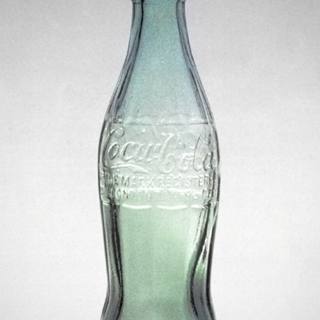
Coca-Cola embossed contour bottle, 6 fl oz
Most likely value
$5-12
- Item
- 6 oz embossed contour (hobbleskirt) bottle
- Era
- Embossed contour type, roughly 1915-1950s
- Material
- Pale green (Georgia green) glass, machine-made
The patent date on the side and the city on the base decide the value: 1915 patent bottles from small towns can bring $25-75 or more, while common 1923 and 1937 patent bottles are a few dollars each.
What decides the value of an odd find?
The maker's mark. In nearly every group here, the maker splits the market. An unmarked cast iron pan sells for $10-40, a common Wagner or Lodge for $20-60, and Griswold #8 for $30-200 depending on the logo, as our old cast iron skillet guide explains.
The size or model number. Collectors want one of everything, so the scarce sizes bring the money. A Stanley No. 4 is a user's plane at $40-80, while the No. 1, the same design at a third the size, brings $1,000-2,500, per our antique tools guide. Tiny #2 and huge #13 skillets beat the everyday #8.
Original finish. Do not clean, polish or repaint anything first. Refinishing often halves the value of tools, metalware and militaria, and the remaining japanning on a plane or the original paint on a sign is part of the price.
A traceable story. For militaria, provenance is the value. A British WWI medal named on the rim to a soldier whose service can be traced, or a Purple Heart with papers showing who received it, can be worth hundreds to thousands, where an unnamed campaign medal is $10-50. Our military medals guide covers naming.
Original or reproduction. Reproduction signs sell for $10-40 and decorative swords for $30-200, and modern knapped points are made to look ancient. In these categories fakes often outnumber the real thing.
Material. Porcelain enamel signs outsell tin. Native gold sells near its metal value of about $3,900 an ounce, and a real meteorite brings about $1-20 a gram.
How to tell if yours is one of the valuable ones
- Ask what it does first. Function, then material, construction, marks and wear, in that order. Our found something, what is it guide walks through all five.
- Turn cast iron over. The logo, size number, pattern number and heat ring on the bottom identify the pan, as our Griswold guide shows.
- Read the number cast at the toe of a plane. Our Stanley plane guide lists what each brings.
- Check a medal's rim or back for a name and number. Named and traceable is a different market.
- Check a sword's ricasso and spine for maker's marks, inspector stamps and dates.
- Look at where a bottle's mold seam stops and how the lip was made. A seam over the lip means machine-made, after about 1910. A rough pontil scar on the base means older, as our antique bottles guide explains.
- Test a rock at home with a streak plate, a magnet, a hardness check and its weight. Our valuable rocks guide explains the tests, and most results are honestly "common rock".
- Lift a sign and check its chips. Porcelain is heavy for its size, and a chip shows dark, rusted steel underneath.
What to photograph
Photograph the whole object with something for scale, then the marks: the base of a pan, the toe and lever cap of a plane, the rim and reverse of a medal, the blade near the hilt, the embossing and base of a bottle, the bottom edge of a sign. Add any damage close up, such as a crack in cast iron, a chip in porcelain or a repair. For rocks and fossils, take a clear close-up of the surface in daylight and a photo next to a ruler, because size sets the price of a shark tooth or arrowhead.
Where to sell, and who can settle it for real
Most finds sell best on eBay or locally, priced from sold listings rather than asking prices, after roughly 13.6 percent in eBay fees. Our what is it worth page explains the method.
The specialists are different for each kind of thing. Rare tools go to dedicated tool auctions such as Brown Auction Services and Martin J. Donnelly Antique Tools, which assess photos first. Swords that look Confederate, Japanese and hand-forged, or named, belong with a militaria auction specialist or arms and armor appraiser, and Japanese blades with a shinsa by the NBTHK or NTHK. Possible meteorites go to a university meteorite lab. For arrowheads that look Paleo, documentation of where they were found carries much of the value, as our arrowheads guide explains.
New to this? Start with the method that works for every category: how to find out what something is worth, which compares Google Lens, eBay sold listings, dealers, auctions, appraisers and photo apps.