Most old books, comics and records are worth a few dollars each. Book club editions of famous novels sell for $1-10, and late 1980s and 1990s comics and the easy listening, Broadway and Christmas albums that fill inherited collections for about $1-5. The money is in specific copies: a true first printing of an important book in its dust jacket, a Silver Age or Bronze Age key issue with a first appearance, or an original first pressing of a collected album. A To Kill a Mockingbird first printing in its jacket can bring $8,000-30,000, and original 1950s and 1960s Blue Note LPs $100-1,000 and up.
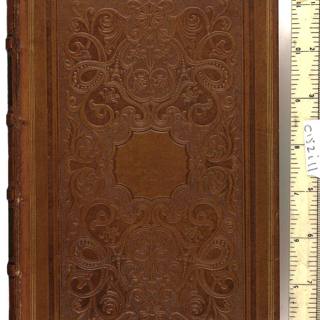
Victorian Blind-Blocked Leather Binding, Title Unknown (c. 1840s-1860s)
Most likely value
$25-75
- Format
- Hardcover in full brown calf, blind-blocked boards
- Era
- Binding style suggests roughly 1840s-1860s
- Condition
- Very good binding: sharp embossing and bright gilt
With a decorative Victorian binding the text inside decides almost everything: a notable first edition could reach the hundreds, while a sermon collection or odd volume usually sells for $20-60.
What decides the value of old books, comics and records?
The exact edition, issue or pressing. For books, a first printing of the first edition is what collectors want, and a later printing of the same title is worth a fraction. For records, the original pressing beats a later one or a reissue, which usually sells for $10-40. For comics, a first appearance is a key, the next issue often is not.
Demand. Scarcity alone does not make value. A rare 1920s textbook can be worth $10, while a Stephen King Carrie first printing in its jacket brings $1,000-3,000.
The dust jacket and sleeve. On modern first editions, the jacket can be most of the value. A Great Gatsby first without its jacket sells for $5,000-20,000, with the jacket $100,000 and up. Ring wear and splits on a record sleeve cost a valuable pressing a large share too.
Condition and grade. Comics are graded on a 10 point scale, and for modern books a 9.8 can sell for many times a 9.6. Records are graded on the Goldmine scale, vinyl and jacket separately.
Signatures and provenance. A signature adds about $10-50 to most modern books, and thousands to a true first by a major author whose signatures are scarce. See our signed books guide.
How to tell if yours is one of the valuable ones
- Read the copyright page of a book. Look for "First Edition" or "First Printing" and a number line where the lowest number is 1. Our guide on whether your book is a first edition covers publisher conventions.
- Rule out a book club edition. A jacket with no price on the front flap, a blind stamp on the back board and a slightly smaller size usually mean a book club copy worth $1-10.
- Check the comic's cover price and indicia. The small print on the first inside page gives the publisher and date. A 12 cent cover price points to the Silver Age. Our old comic books guide lists the key issues.
- Read the record label and the runout. Note the label design, catalog number and the matrix numbers etched in the runout groove, then search them on Discogs. Our vinyl records guide explains first pressings, mono copies and Blue Note originals, and the 78 rpm guide covers shellac, where most records are $1-5.
- Check Harry Potter copies against the true first. A 1997 Bloomsbury hardback first printing sells for about $25,000-60,000 in typical worn condition, but most copies called first editions are later printings worth $10-50. Our Harry Potter guide shows the points.
- Watch for facsimiles and fine bindings. Easton Press and Franklin Library books usually sell for $20-100, and comic reprints of famous keys for $5-30. The same caution applies to old Bibles and old maps, where reprints are common.
What to photograph
For a book, photograph the copyright page flat and sharp, the title page, the spine, the front jacket flap and any signature. For a comic, shoot the front and back covers in even light, the spine and corners close up, and the indicia. For a record, photograph both labels straight on, the runout groove with light across it so the etched matrix reads, the front and back of the jacket, and the vinyl surface under a light.
Where to sell, and who can settle it for real
For books worth real money, a member of the Antiquarian Booksellers' Association of America (ABAA) or ILAB, or the book department of an established auction house, can confirm points of issue and give an estimate. Sold listings on eBay show what common titles bring.
For comics, CGC is the largest grading service, with CBCS and PGX as alternatives. Grading costs tens of dollars a book and up, so it pays only for books likely worth more than about $100 graded. Graded keys sell through comic auction houses and eBay.
For records, check the Discogs sold history for your exact matrix, then sell common records as lots to a local shop and valuable pressings through Discogs, eBay or a specialist dealer. Old paper that turns up alongside is covered in our old magazines guide.
New to this? Start with the method that works for every category: how to find out what something is worth, which compares Google Lens, eBay sold listings, dealers, auctions, appraisers and photo apps.