Most antiques found in homes sell for roughly $20-300. A Victorian dresser often brings $50-500, an old mantel clock $50-200, a pressed glass bowl $5-30, and a full set of inherited fine china for 8 or 12 often only $100-500. Most paintings that come out of estates are prints, reproductions or work by amateur painters, and sell for about $20-200. Age alone does not make something valuable. The pieces that bring thousands are tied to a known maker or a listed artist, are early handmade work in original condition, or belong to a short list that collectors chase, such as Roseville's Futura and Pine Cone, signed Venini glass or a 1960s Eames lounge chair.
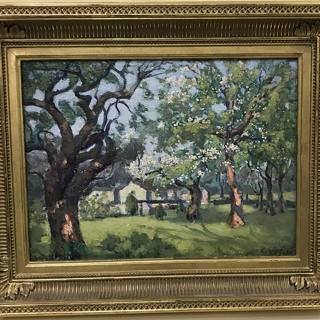
Impressionist-style oil painting of a spring orchard with farmhouse, signed lower right
Most likely value
$200-500
- Type
- Landscape, appears to be oil, in a gilt frame
- Signature
- Lower right, name not readable with confidence from this photo
- Era
- Style consistent with early to mid 20th century
The name is the whole story: if the signature matches a listed artist with an auction record, the value could rise into the hundreds or low thousands. An unknown hand keeps it in the decorative range.
What decides the value of an antique or a painting?
Maker or artist. This matters more than anything else in the category. A signed painting by an amateur sells for about $50-500, and the same subject by a listed artist with an auction record can be worth many times that. Most glass sold as "Murano" brings $15-75, while a signed Venini handkerchief vase brings roughly $200-750, as our Murano glass guide explains.
Original or reproduction. A print with a famous name on it is still a print. Famous pottery marks such as Meissen's crossed swords and Roseville's raised script have been copied for decades, and Chinese copies of the best Roseville patterns have been sold since the 1990s. Several depression glass patterns were remade from the 1970s onward.
Pattern, line and color. Inside one maker, the line decides the price. Most Roseville sells for $40-250, while Futura, Sunflower and early Della Robbia bring $300-3,000 and more, and a blue Pine Cone vase can bring two to three times the same shape in green.
Condition. A chip or a hairline crack cuts pottery to half or less. Refinishing hurts furniture, and amateur cleaning is one of the most common ways a painting loses value.
Design and current demand. Taste has moved. Victorian "brown furniture" now sells for about $50-500, while labeled mid-century lines like Broyhill Brasilia and Lane Acclaim bring $300-1,500 a piece, per our mid-century furniture guide.
Metal content. Sterling silver is worth at least its weight in silver, while silver plate sells for a few dollars a piece. Our guide to sterling versus plate shows the marks.
How to tell if yours is one of the valuable ones
- Turn it over. The underside of a plate, vase or figurine carries the backstamp, which names the maker, the country and often the decade. Our guide to reading pottery marks explains impressed, printed and painted marks.
- Check the country wording. "Nippon" was used on Japanese exports from 1891 to 1921, and "Made in Japan" after that, so the wording alone narrows the date.
- Look at the back of a painting. Gallery labels, exhibition stickers, framer's stamps and inscriptions on the stretcher can be worth more than the signature. Under a magnifier, a regular dot pattern means a print. Our page on identifying an artist signature shows how to search a name from a few letters.
- Pull out a drawer. Uneven hand-cut dovetails and hand tool marks point to before about 1860; machine dovetails, round saw marks, plywood, staples and Phillips screws point later. Our antique furniture identification guide walks through it.
- Look inside drawers for labels. A Broyhill Premier stamp or "Made in Denmark" mark can make a dresser worth several times an unmarked one.
- Read the back of silver handles for 925, STERLING or hallmarks.
What to photograph
Photograph the piece straight on, then the mark or label close up without glare. For pottery, porcelain and glass, the underside is the most important photo, plus a close-up of any chip, crack or repair. For paintings, take the whole front, the signature close up under raking light, and the entire back with any labels. For furniture, photograph the whole piece, a pulled-out drawer showing the dovetails, the back panel and any stamps or paper labels.
Where to sell, and who can settle it for real
Small, shippable pieces under about $500 do well on eBay, at about 13.6 percent in fees. Furniture sells best locally, through a regional auction, a consignment shop or a marketplace listing. Pieces worth a few thousand dollars or more usually do best at an established auction house: Heritage, Freeman's | Hindman, Bonhams or a good regional house for general antiques, and Wright and Rago for mid-century design. Our guide on where to sell antiques compares fees.
For a painting by a listed artist, an auction house paintings department will usually look at photos and give an estimate at no charge. For insurance, estate or donation purposes, an accredited appraiser from the ASA, ISA or AAA writes a formal appraisal for roughly $125-350 an hour, as our antique appraisal guide explains.
New to this? Start with the method that works for every category: how to find out what something is worth, which compares Google Lens, eBay sold listings, dealers, auctions, appraisers and photo apps.