Most coins are worth face value or a few cents more. Four groups pay. US dimes, quarters and halves dated 1964 or earlier are 90 percent silver, worth about $3.60, $9 and $18 each in metal at November 2026 spot of about $49.50 an ounce, and a Morgan or Peace dollar holds about $38 of silver. A short list of key dates, mint marks and genuine errors brings $10 to five figures. Old gold is worth hundreds to thousands for the metal alone. And true uncirculated coins can bring several times a worn example of the same date.
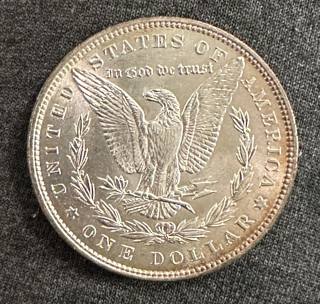
USA Morgan Silver Dollar (date not shown)
Most likely value
$55-90
- Composition
- 90 percent silver, 0.7734 oz pure silver
- Mint mark
- None seen below the wreath bow, which points to Philadelphia
- Condition
- Appears uncirculated or very close (MS-60 range)
The date and mint mark decide everything: an 1893-S, 1889-CC or 1895 would be worth hundreds to thousands.
What decides the value of a coin?
Metal. This is the floor. A 1965 to 1970 Kennedy half is 40 percent silver, about $7.30, and a 1942 to 1945 nickel with a large mint mark above Monticello is a war nickel worth about $2.80. Our silver coin value table lists the silver content of every US type. A common $20 US gold coin holds about $3,800 of gold at $3,940 spot and sells for a little more.
Date and mint mark together. A 1932 Washington quarter is worth its silver, while a 1932-D is worth $100 or more even worn. A worn 1921 Morgan dollar is about $40 to $50, an 1893-S $3,000 and up. The guides for pennies and dimes list the key dates by year.
Varieties and errors. Off-center strikes and clips sell for about $5 to a few hundred dollars, and the 1955 doubled die cent reaches five figures. Most odd-looking coins are damage, and our error coins guide shows the difference.
Condition. A common Morgan dollar is about $40 to $50 in Good and $150 to $250 in MS-65, and on scarce dates the gap is far wider. The coin grading scale shows what each grade looks like.
Surface. A cleaned coin typically sells for 30 to 70 percent less than an original one, which is why cleaning old coins is the costliest mistake owners make.
How to tell if yours is one of the valuable ones
- Check the edge. On a US dime, quarter or half, a solid silver-white edge means silver. A copper stripe means clad, which is face value unless it is an error.
- Find the mint mark. A small P, D, S, O, CC or W, usually on the reverse on older coins and near the date from 1968 on. No letter usually means Philadelphia.
- Compare against the key list for that series, such as the 1909-S VDB cent, 1916-D dime, 1932-D quarter and 1893-S Morgan.
- Look at the high points. Lincoln's cheek, Washington's hair above the ear, Liberty's knee on a Walking Liberty half. Flat and smooth means circulated.
- Be skeptical of famous coins. Almost every copper-looking 1943 penny is plated steel or an altered date. A genuine 1943 bronze cent has sold for $240,000 to $840,000.
- For world coins, read the legend. HELVETIA is Switzerland, SVERIGE is Sweden, EIRE is Ireland. Our foreign coins guide covers which ones carry silver.
What to photograph
Photograph both sides straight on, filling the frame, in soft light without glare. Add sharp close-ups of the date and the mint mark. For any dime, quarter or half, tilt the coin toward the light and photograph the edge, since that one shot settles silver versus clad. Shoot any doubling or oddity close up and again from a slight angle, which separates damage from a strike error.
Where to sell, and who can settle it for real
Common silver sells best to a local coin shop or bullion dealer, usually at 90 to 100 percent of melt. At $49.50 silver, $1 face value of 90 percent coins holds about $35 of metal, so expect roughly $32 to $35. Do not pay to grade it.
For a key date, a listed variety, a clear error or an uncirculated older coin, get a first look from a coin dealer or coin club, then consider PCGS or NGC, which authenticate and grade. NGC lists $20 to $45 per coin at its slower tiers plus a handling fee and shipping, so grading makes sense for coins likely worth $100 or more.
Coins worth $1,000 or more usually do best at Heritage or Stack's Bowers, which charge buyers 22 percent. eBay suits mid-range coins at 13.25 percent plus $0.40 an order. Our guide on how to sell coins compares the routes, and inherited coins shows how to sort an estate lot first.
New to this? Start with the method that works for every category: how to find out what something is worth, which compares Google Lens, eBay sold listings, dealers, auctions, appraisers and photo apps.