Most old electronics sell for modest money, and whether the thing works decides more than its age. A plastic point and shoot usually sells for $5-30, a working Canon AE-1 or Pentax K1000 with its lens $80-250, a small working receiver for $50-300, an old flip phone for $5-30, a loose Nintendo cartridge for $5-40, and a working Commodore 64 for about $50-200. The exceptions are specific models that collectors and users want: a Contax T2 at roughly $900-1,500, a Leica M3 body at $1,200-2,500, a big 1970s Marantz or Pioneer receiver at $800-4,000 and more, an original 1984 Macintosh 128K at $1,500-5,000, rare games in the hundreds or thousands, and anything early and still sealed.
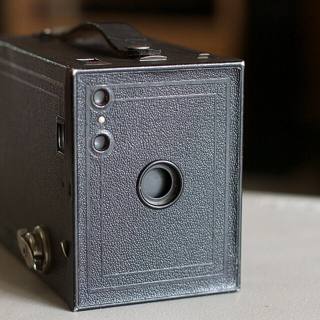
Kodak Brownie No. 2 Box Camera (Model F era, about 1920s-1930s)
Most likely value
$10-25
- Model
- Consistent with No. 2 Brownie, likely Model F
- Type
- Box camera, fixed-focus lens, 120 roll film
- Condition
- Good cosmetic condition, function untested
No. 2 Brownies were made in the millions, so they are common decorator pieces. Colored Model F variants, an original box and booklet, or a working shutter bring more.
What decides the value of old electronics?
The exact model. One letter in a model name can change a camera's price several times over, and the gap between a mid-power receiver and the flagship next to it on the shelf can be thousands of dollars. Our vintage stereo receiver guide lists the Marantz, Pioneer, Sansui and Kenwood models by price, and our vintage turntable guide does the same for decks, where a Technics SL-1200 MK2 brings $400-1,000 and a Garrard 301 more.
Whether it works. A receiver with a dead channel, scratchy controls or dark lamps sells for a third to a half of a working one. Dead compact Macs sell for a third to a half of booting ones. An untested camera sells for 30-50 percent of a working one.
Glass and internal condition. For lenses, fungus, haze, separation or a stuck aperture can cut the value by half or more. Most old lenses bring $20-150, and fast primes and Leica, Zeiss and Voigtländer glass $300-3,000, as our vintage camera lens guide explains.
Film and media you can still buy. A Polaroid camera's value starts with whether film is still made for it. A working SX-70 brings $100-300, while the boxy 600 models sell for $15-50, per our Polaroid camera guide.
Box and completeness. For games, the cardboard box and manual multiply the price. On the Nintendo 64, Super Mario 64 is about $39 loose and $136 complete, and Conker's Bad Fur Day about $148 loose and $344 complete. A boxed original Game Boy brings about $150-400, against $40-100 loose.
Firsts and sealed examples. The first model of something important is collected as history. A used 2007 original iPhone sells for $100-500, and a factory sealed one sold for $190,372.80 in 2023.
How to tell if yours is one of the valuable ones
- Read the model name and number on the front or top plate of a camera, the faceplate of a receiver, or the label on the back of a computer or handheld. A Game Boy label reads DMG-01, CGB-001, AGS-101 and so on, as our Game Boy guide shows.
- Read the front ring of a lens for maker, focal length, maximum aperture and serial number. Anything at f/1.4 or faster deserves a closer look.
- Shine a flashlight through the lens and look for fog, web-like fungus or bubbles between elements.
- Count the watts on a receiver's back panel or spec plate. The high-powered flagships of about 1973 to 1980 are the valuable ones.
- Check a game cartridge's label and screws. Reproductions of valuable titles are common, and the rare games are exactly the ones that get faked. Our old Nintendo games guide covers the checks.
- Look for the original box and manuals, often rarer now than the hardware.
What to photograph
Photograph the front straight on so the model name is legible, then the label or serial plate. For cameras, add the top plate and the lens front ring. For lenses, photograph both ends and a shot through the glass toward a light. For audio, show the faceplate with the unit powered on and lamps lit, and the back panel. For games, photograph the cartridge label front and back and any box on all sides. A photo of it running is the best evidence.
Where to sell, and who can settle it for real
A local camera shop or repair technician can test a camera body in minutes. Selling to a camera shop usually brings 40-60 percent of the eBay sold price, so for Leica, Hasselblad and similar gear a specialist camera dealer or camera auction is better. Heavy audio travels badly, so a local sale or a dealer is often safest, and Reverb and eBay work for smaller pieces.
For games, local retro game stores test carts and usually pay 40-60 percent of the online sold price. Price from PriceCharting and eBay sold listings. Sealed and high-value complete games are graded by WATA Games or VGA, at roughly $30-150 per game for typical values. Rare early computers, such as an original Apple II, have sold through RR Auction, and our vintage computer guide covers which machines justify that route.
New to this? Start with the method that works for every category: how to find out what something is worth, which compares Google Lens, eBay sold listings, dealers, auctions, appraisers and photo apps.