Most jewelry is worth what its metal weighs. As of early November 2026, with gold around $3,950 an ounce, 14K gold holds about $74 per gram, 10K about $53 and 18K about $95, and buyers pay roughly 70-90 percent of that for scrap. With silver near $49.50, sterling holds only about $1.50 per gram. Unsigned costume pieces sell for $1-15 each, or $20-100 as a drawer lot. The pieces that sell above their metal are natural diamonds over about half a carat, signed makers from Cartier down to Trifari, fine period pieces and good Native American silver.
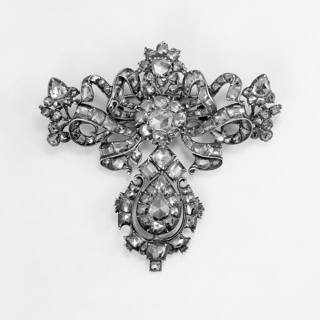
Georgian-Style Bow and Pendant Brooch (Sévigné Type) with Rose-Cut and Table-Cut Stones
Most likely value
$2,000-8,000
- Type
- Ribbon-bow brooch with a pear-shaped drop
- Metal
- Not readable, white-metal settings consistent with silver
- Era
- Design consistent with the mid to late 18th century
The biggest factor is whether the stones are rose-cut diamonds or paste: a period piece with diamonds can reach five figures, period paste usually the low thousands, a modern reproduction a few hundred dollars.
What decides the value of jewelry?
The metal and its purity. For unsigned gold, the price is grams times purity times the gold price. A 20 gram 14K chain holds about $1,480 in gold. Our 10K vs 14K vs 18K guide has the per-gram table and how to scale it, and gold filled vs gold plated explains why GF and plated pieces hold only a dollar or a few in gold.
The stones. Small diamonds and most colored stones add little at resale. A diamond starts to matter more than the metal around half a carat, and natural stones resell for about 20-50 percent of retail. A natural 1 carat stone typically resells for about $1,000-4,000, a lab-grown one $50-300. Our diamond value guide covers how the 4Cs move the number.
The maker. A signature can multiply value. Used Cartier Love bracelets in yellow gold resell for about $5,500-7,500, Van Cleef Vintage Alhambra pendants about $2,500-3,500. In costume jewelry, signed Trifari brings $15-100, 1940s Trifari jelly bellies $200-800, Haskell necklaces $100-500, and vintage Chanel costume $300-2,000.
Era and craftsmanship. Victorian and Edwardian gold brooches and rings often bring $100-3,000, and Art Deco platinum diamond rings $500-5,000. Our antique ring guide covers the construction clues.
Condition. Missing stones, dark rhinestones, broken clasps and verdigris cut costume prices hard.
How to tell if yours is one of the valuable ones
- Find the stamp. Look inside ring shanks, on clasps and on bails. 10K, 14K, 18K, 417, 585 and 750 mean solid gold. 925 or Sterling means silver. PT950 or PLAT means platinum. Our guide to reading jewelry hallmarks covers British and European marks too.
- Watch for the plating marks. GF, RGP, GP, HGE and 1/20 12K GF all mean a thin gold layer over base metal, not solid gold. A 925 piece with gold color is vermeil, worth its silver. Our guide on whether old jewelry is real gold shows the marks that fool people.
- Look for a maker's signature. On costume jewelry it is often on the back of a brooch, the clasp or a small oval plate. Crown Trifari, Coro, Weiss, Haskell, Eisenberg and Chanel are the names to look for, all covered in our costume jewelry guide.
- Check signed fine jewelry marks. Real Tiffany, Cartier and Van Cleef carry the brand, a purity mark and often a serial.
- Skip the magnet and bite tests. Many plated pieces are not magnetic. A jeweler's acid or electronic test settles it in minutes.
- Measure the stone. A round diamond about 6.4 millimeters across is roughly 1 carat. Anything that size deserves a tester before it goes anywhere near a gold buyer.
What to photograph
The stamp is the single most useful photo. Shoot it close with light from the side so the letters cast shadows. Then photograph the piece front and back, any signature, the stones from top and side, the setting from behind, and the clasp or pin, which helps date brooches. If you have a kitchen scale, put the weight in grams in a photo.
Where to sell, and who can settle it for real
For plain gold, refiners pay about 90-97 percent of melt on larger lots, good gold buyers and coin shops about 70-90 percent, and pawn shops often 50-80 percent. Our where to sell gold guide explains how to test an offer. For diamonds, a jeweler who buys estate pieces or an online auction like Worthy usually beats a gold buyer, who may pay only for the band. Signed Cartier, Tiffany or Van Cleef does best on consignment, where sellers keep about 55-70 percent. Our where to sell jewelry guide compares the routes.
For a formal value, use a GIA Graduate Gemologist who is also an accredited appraiser with ASA, AGS, NAJA or ISA. A written appraisal costs roughly $75-250 a piece, and you should ask for fair market value if you are selling, since insurance figures run far above what buyers pay. See our jewelry appraisal guide. For a diamond of 1 carat or more, a GIA lab report settles the grades.
New to this? Start with the method that works for every category: how to find out what something is worth, which compares Google Lens, eBay sold listings, dealers, auctions, appraisers and photo apps.