Most stamps are worth a few cents, and a full family album of common used stamps often sells for roughly $20 to $200. Most old paper money is worth a little over face: a 1935 or 1957 blue seal $1 silver certificate brings about $1.50 to $4 worn and $8 to $20 crisp. The exceptions: for stamps, issues from before about 1900, mint stamps with untouched original gum, known errors and scarce stamps in sound, well-centered condition. For banknotes, large size notes from before 1929, unusual seals and overprints, star notes from small print runs, fancy serial numbers, genuine printing errors and crisp uncirculated paper.
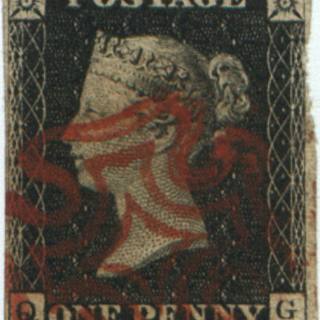
Great Britain 1840 Penny Black, lettered Q-G
Most likely value
$80-250
- Catalog
- SG 2 (or SG 1 intense black), Scott 1
- Letters
- Corner letters Q-G, plate not readable from this image
- Condition
- Used, roughly Fine at best, margins look tight
For used Penny Blacks the drivers are four clear margins, a light cancel and the plate number: plate 11 and plate 1a are the scarce ones.
What decides the value of a stamp or banknote?
Age and print run. Stamps from the 1920s on were printed by the billion and saved by the album, so a used 1950 commemorative is still worth a few cents. Nineteenth century issues and a country's first few stamps are where value starts.
Type of note or stamp. A 1928 red seal $1 sells for about $270 to $370 in Fine to Very Fine. A circulated Series 1929 national bank note from a big-city bank is about $30 to $150, and the same note from a rare small town can bring ten or twenty times that (see national bank notes).
Errors and varieties. The Inverted Jenny and the 1869 and 1901 inverts top the most valuable US stamps, but nearly every one found in an album is a reproduction. Genuine currency errors bring about $20 to $100 when minor and several hundred to several thousand when dramatic. Ink stains and scissor cuts are damage, worth face at most. Our misprinted money guide shows the difference.
Serial numbers. Most modern star notes are worth face to $3 over, and older or small-run stars $10 to several hundred. A fancy serial usually adds $5 to $50, a crisp $1 radar sells for about $25 to $50, and solid serials can pass $1,000 (fancy serial numbers).
Condition. On mint stamps the back decides the price: never hinged gum is the top grade, a hinge mark cuts twentieth century stamps by half or more, and a thin takes 50 to 90 percent off. On notes, folds, stains and pressing separate a few dollars from many times that.
How to tell if yours is one of the valuable ones
- Turn mint stamps over, then hold them to the light. Undisturbed gum is worth far more than a hinge remnant, and the light shows thins, creases and pinholes. Our stamp value guide covers gum, centering and regumming.
- Check the seal color on bills. Green is ordinary. Blue, red, gold and brown, plus overprints like HAWAII, deserve a closer look.
- Measure the note. Bills noticeably larger than today's are large size, from 1928 or earlier.
- Read the serial number for a star, a very low number, or a pattern such as a radar or solid. Our star notes guide explains how to check a run.
- Be wary of Confederate notes. Most found at home are 1950s and 1960s reproductions worth $0 to $2, while a typical genuine 1864 note brings $20 to $60 (Confederate money).
What to photograph
For stamps, photograph the front flat and square so centering and all four perforated edges show, then the back of any mint stamp to show gum and hinges. Watermarks, perforation gauges and paper types do not show reliably in a phone photo, so a possible classic variety needs an expert in person.
For banknotes, photograph both sides flat with the whole note in frame, then close-ups of the seal, series date and full serial number.
Where to sell, and who can settle it for real
Catalog value is a retail reference, not a sale price. Dealers typically pay about 5 to 20 percent of catalog for common material, more for scarce stamps in sound condition. For a possible rarity, the American Philatelic Society lists member dealers and offers expertizing, as do Professional Stamp Experts and the Philatelic Foundation. Unused US postage from the 1940s on sells for about 50 to 70 percent of face, so using it on mail is usually worth more (Forever stamps). Our inherited stamp collection guide covers sorting an album first.
A local coin and currency dealer can sort a stack of notes quickly. PMG and PCGS Banknote grade notes on a 1 to 70 scale, at roughly $25 to $80 per note for standard service, which pays for notes likely worth $150 or more. Rare notes do best at currency auctions such as Heritage. See our old dollar bills and silver certificate guides.
New to this? Start with the method that works for every category: how to find out what something is worth, which compares Google Lens, eBay sold listings, dealers, auctions, appraisers and photo apps.