Most trading cards are worth cents. Sports cards from about 1986 to 1994 were printed by the hundreds of millions and usually sell for $0.01 to $0.10 each, a shoebox of old Pokemon commons often brings $10 to $40 as a lot, and Yu-Gi-Oh or Magic bulk goes for roughly $5 to $20 per thousand. The money sits in a narrow slice: sports cards from before 1970, key rookies, serial numbered parallels and autographs, Pokemon holos from the 1999 to 2003 Wizards era, 1st Edition stamps, early Magic printings and Reserved List rares. On those, condition and grade decide whether a card is worth a few dollars or thousands.
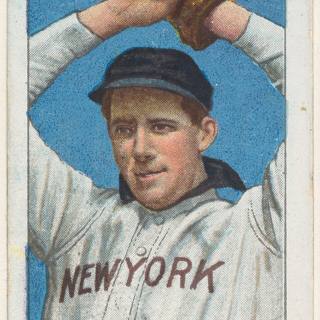
T206 Joe Doyle, New York (Hands Above Head), American Tobacco Company 1909-1911
Most likely value
$80-180
- Set
- T206 White Border (American Tobacco Company)
- Variant
- Common caption 'DOYLE, N. Y.', no 'Nat'l'
- Condition
- Played, roughly Good to Very Good, all four corners rounded
The famous rarity is the 'DOYLE, N.Y. NAT'L' error version of this pose, worth six figures, and this card does not show that wording. The tobacco brand on the back can multiply the value several times.
What decides the value of a trading card?
Era and print run. A creased 1955 Topps star can be worth more than a whole box of 1988 Topps kept in perfect order. Our old baseball cards guide sorts a collection by year.
Player or character. A 1986-87 Fleer Michael Jordan #57 is worth hundreds raw and six figures in PSA 10. In Pokemon, Charizard leads, and a Base Set Charizard ranges from about $150 to $300,000 depending on print and grade, as our Charizard guide explains.
Printing and edition. A 1st Edition Base Set holo is often five to ten times the Unlimited copy, and a shadowless card two to four times. In Magic, Alpha, Beta and Unlimited from 1993 sit above everything else, and a played Revised Underground Sea still sells for $400 to $800. In Yu-Gi-Oh, 1st Edition LOB holos are the cards to find.
Serial numbering. On modern cards a /99 parallel of a star rookie is often $50 to $500, a 1/1 of the same player thousands, and a /299 of a role player $5 to $20.
Condition and grade. Graders weigh centering, corners, edges and surface, and the weakest usually sets the grade. On modern cards a PSA 10 often sells for three times a PSA 9 or more, so one soft corner can erase most of the value.
How to tell if yours is one of the valuable ones
- Read the copyright year on the back. Pre-1970 sports cards deserve a closer look, and 1986 to 1994 cards usually do not.
- Look for "RC" or a first-year card of a Hall of Fame player or current star.
- Check for a serial number stamped on the front or back, such as /25 or 1/1, and for on-card autographs.
- On Pokemon, check below the art box. A black EDITION 1 stamp on the left means 1st Edition.
- On Magic, check the border and corners. Black borders point to Alpha or Beta, Alpha with rounder corners, and no set symbol to a 1993 or 1994 core printing (old Magic cards).
- Be suspicious of famous cards in a shoebox. A 1952 Topps Mantle or 1986 Fleer Jordan in a shoebox is far more likely a reprint. Card stock, gloss and the dot pattern under a loupe settle most cases, as our reprint guide shows. For Pokemon, the flashlight test and the holo pattern catch most fakes.
What to photograph
Shoot the front and back flat and square, in even light, with all four borders in frame for centering. Add close-ups of the bottom strip on Pokemon and TCG cards, with set symbol, number and edition stamp, and of the copyright line on sports cards. Photograph any serial number, autograph or soft corner up close, and add one shot tilted under a lamp to show surface scratches. For a graded card, include the full label with its serial number.
Where to sell, and who can settle it for real
Serious buyers pay for a grade from PSA, BGS or CGC. PSA usually brings the highest resale, BGS suits cards that might earn a Black Label 10, and CGC is cheaper and faster. As of October 2026 PSA starts at $59.99 a card with its Value tiers paused, and CGC runs about $17 to $20, so grading pays only for cards worth roughly $100 or more raw that could reach a 9 or a 10. Our grading comparison and is grading worth it guides run the numbers.
To sell, Pokemon and other TCG singles worth $5 or more go well on TCGplayer or eBay at roughly 13 to 15 percent in fees. Sports cards sell best on eBay at 13.25 percent, and graded cards worth several hundred dollars or more can go to Fanatics Collect or Goldin. Our guides on selling sports cards and selling Pokemon cards cover each route.
New to this? Start with the method that works for every category: how to find out what something is worth, which compares Google Lens, eBay sold listings, dealers, auctions, appraisers and photo apps.